Marketplace Operations Management
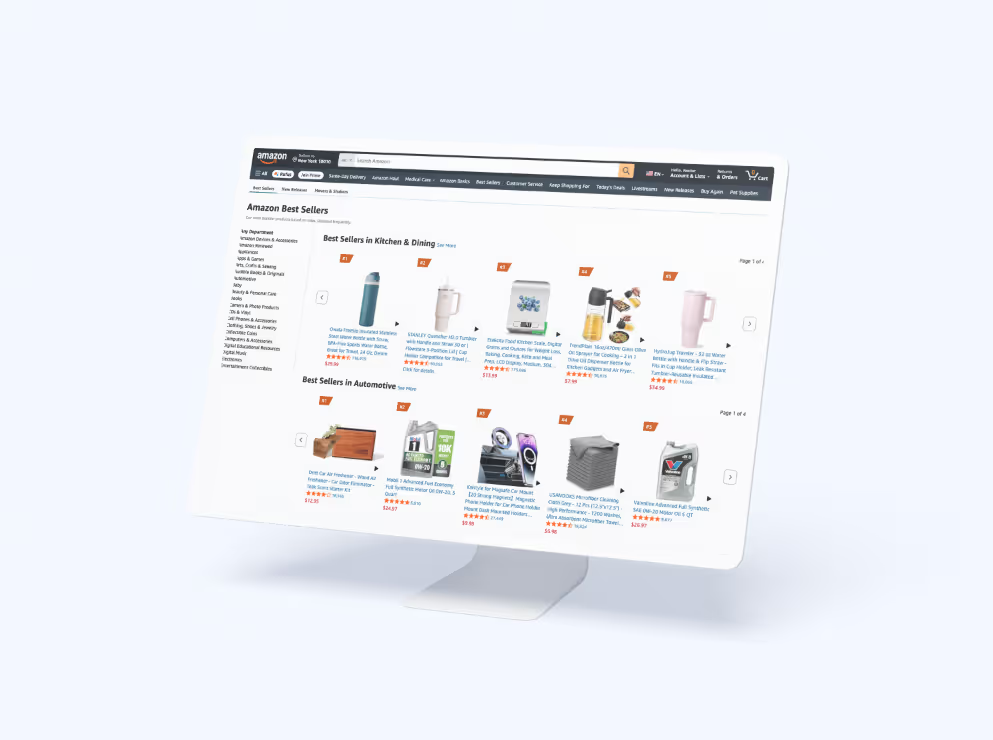
Marketplace Operations Management: Day-to-Day Excellence That Protects and Grows Your Business
Marketplace operations encompasses the essential but often-overlooked work that keeps your business running smoothly: managing Seller or Vendor Central accounts, optimizing fulfillment, resolving cases, auditing fees, maintaining catalog quality, ensuring compliance, forecasting inventory, and planning promotions. These operational details directly impact profitability - a single unresolved chargeback can cost thousands, while poor inventory forecasting leads to stockouts that kill sales momentum and damage search rankings.
Marketplace operations encompasses the essential but often-overlooked work that keeps your business running smoothly: managing Seller or Vendor Central accounts, optimizing fulfillment, resolving cases, auditing fees, maintaining catalog quality, ensuring compliance, forecasting inventory, and planning promotions. These operational details directly impact profitability - a single unresolved chargeback can cost thousands, while poor inventory forecasting leads to stockouts that kill sales momentum and damage search rankings.
Our marketplace management capabilities span the full operational spectrum: Seller Central management including FBA optimization and fee recovery, Vendor Central management with chargeback disputes and PO optimization, catalog and compliance ensuring quality and regulatory adherence, demand forecasting and retail readiness preventing stockouts, and promotional planning maximizing deal effectiveness. Integrated operations management transforms marketplace operations from a cost center into a profit driver.
Marketplace Management Services


FAQ
Seller Central is Amazon’s 3P (third-party) platform where you own inventory, set the price, and run your own marketing. Amazon takes a referral fee. Vendor Central is the 1P (first-party) platform where Amazon places POs, owns the inventory, sets the price, and lists you as the manufacturer. 1P margin is thinner but you get access to AMS campaign types and AMC cleaner data. Most mid-size brands run hybrid: hero SKUs on 1P for volume and Amazon-advertising leverage, long-tail SKUs on 3P for control and margin. Neither is automatically better; the question is where each SKU performs.
A Vendor Central chargeback is an automated financial penalty Amazon deducts from a Vendor invoice when a PO isn’t fulfilled exactly to spec. Wrong carton label, missing ASN, shipment delivered to the wrong FC, or PO not confirmed within the window. There are 50+ chargeback codes and rates range from $0.15 per carton to 5% of the invoice. Chargebacks can eat 2–5% of your 1P revenue if uncontested. They’re recoverable via dispute, but most brands don’t realize how much is on the table until they look.
A Plan of Action (POA) is the document Amazon requires before reinstating a suspended account, structured in three parts: root cause stated plainly with no deflection, immediate corrective action you took this week, and preventive action that systematically blocks recurrence. (1) Root cause. What actually caused the violation, no deflection. (2) Immediate corrective action. What you did this week (e.g., “pulled 47 listings with non-compliant claims, re-uploaded 41 with corrected copy, delisted 6”). (3) Preventive action. What systematic change prevents recurrence (e.g., “implemented pre-publish compliance review by Legal for any product making health claims”). The fastest reinstatements come from POAs that take clear ownership and describe specific, measurable process changes. Vague or evasive POAs extend suspensions by weeks.
When three conditions align: (1) chargebacks and AVN (Annual Vendor Negotiations) allowances are eating more margin than the Vendor-exclusive advertising benefits create; (2) your brand has enough organic pull that you don't need Amazon's 1P merchandising to move units; (3) you have the operational capacity to run your own ads, catalog, and inventory planning. For most mid-size brands, the flip pays back inside 6–9 months once chargeback erosion crosses ~4% of 1P revenue and co-op asks cross 8%. The transition itself is painful. Expect 30–60 days of revenue disruption as ASINs migrate.
To get approved on Walmart Marketplace, you need a US business entity, US tax ID, US-issued business address, US-based inventory or fulfillment, and a track record on another eCommerce platform like Amazon, Shopify, or BigCommerce. Walmart prefers brands with established eCommerce history. Pure first-time sellers face more scrutiny. The application takes 2–4 weeks and includes verification of UPCs, product imagery, and a category-fit review. Approval rates jumped after Walmart opened the marketplace more aggressively in 2023; today most legitimate brands with existing channels get approved within a month.
To get approved on TikTok Shop, you need a US entity, US business documentation, eCommerce history on another platform (Amazon, Shopify), and category fit. Applications take 5–10 business days through TikTok Seller Center. TikTok Shop initially restricted certain categories (firearms, supplements with health claims, alcohol); the eligible category list has expanded since 2023. First-time eCommerce brands face more friction; established brands with social presence get fast-tracked. Approval is denied most often for incomplete tax documentation or for products in restricted categories.
Target Plus is invite-only. There is no application form. Invitations come through Target’s category buyer team, typically targeting brands with proven eCommerce momentum, retail-quality packaging, and strategic fit with Target’s existing assortment. Paths to an invitation: introductions through retailer brokers (Crossmark, Acosta), exhibiting at category trade shows where Target buyers attend, achieving meaningful Amazon/DTC traction that puts you on category buyer radar, or partnering with an agency that has existing Target Plus relationships. Cold outreach to Target.com directly rarely works; relationship-driven introductions almost always do.
Case Studies
See how Nectar's creative and strategy work has lifted partner brands into category leadership and, in several cases, opened growth channels the client hadn't yet considered.


.webp)