Retail Media Advertising

Expert Campaign Management Across All Platforms
Retail media advertising has exploded into a $45+ billion industry as Amazon, Walmart, Target, and other retailers monetize their first-party shopper data through sophisticated advertising platforms. These platforms offer unmatched targeting precision - you can reach shoppers actively searching for products like yours, browsing competitor listings, or exhibiting purchase intent signals. For brands selling on marketplaces, retail media advertising is no longer optional; it's the primary driver of visibility and growth.
Managing retail media effectively requires deep platform expertise, advanced bidding strategies, and rigorous performance optimization. Amazon Sponsored Ads alone encompasses Sponsored Products (keyword-targeted product ads), Sponsored Brands (headline ads with multiple products), and Sponsored Display (retargeting and audience-based display). Beyond sponsored ads, Amazon DSP enables programmatic display and video campaigns across Amazon properties and the open web. For enterprise brands, Amazon Marketing Cloud adds advanced measurement and incrementality analysis.
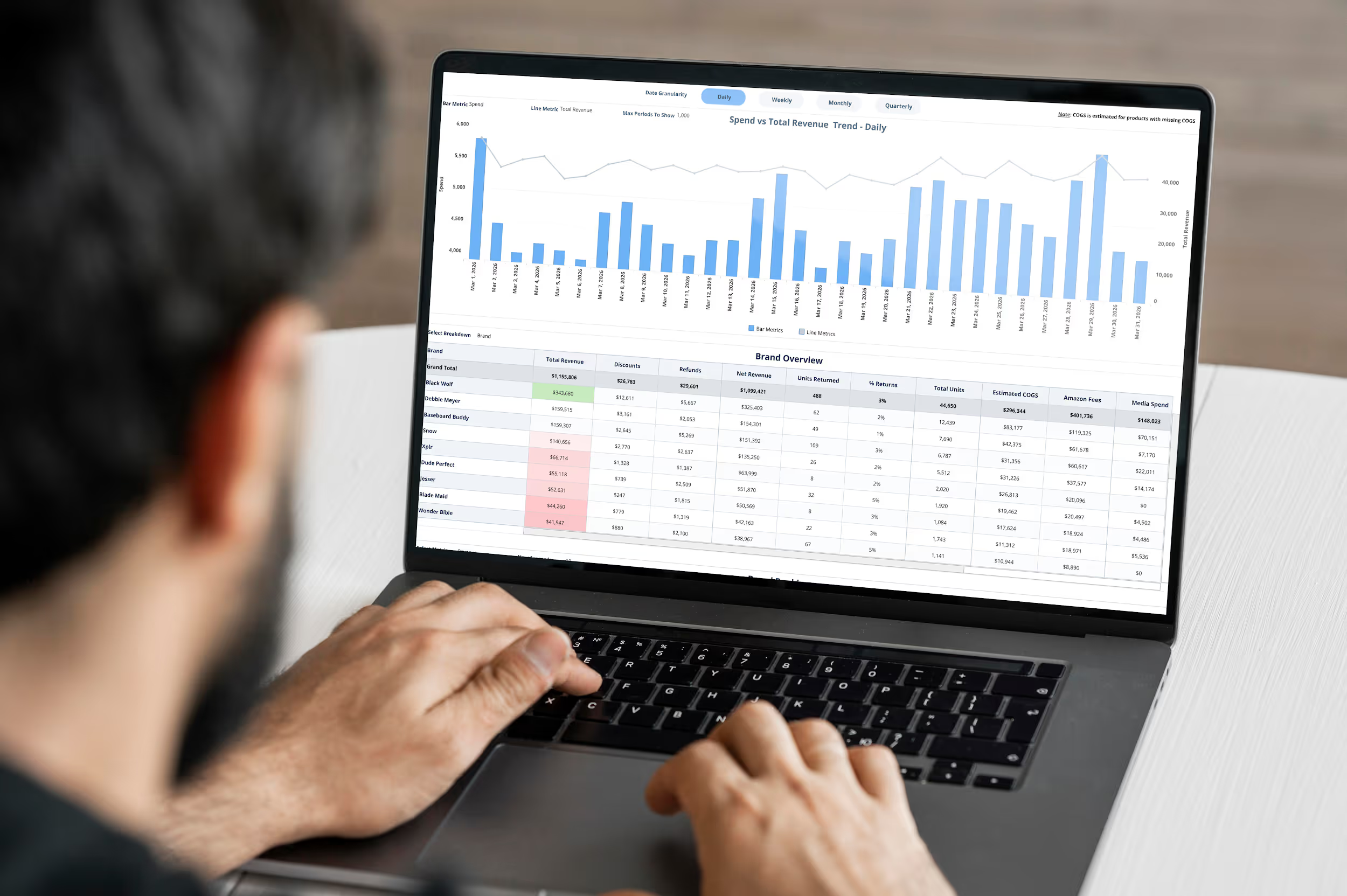
Our retail media team manages six- to seven-figure monthly budgets across Amazon, Walmart Connect, Target's Roundel, Instacart Ads, and emerging platforms. We don't just manage campaigns - We develop full-funnel strategies that balance brand building with performance marketing, coordinate advertising with inventory availability and promotional calendars, and continuously optimize based on real-time performance data flowing through our iDerive analytics platform.
Retail Media Capabilities


Retail Media Capabilities
FAQ
Amazon PPC takes 60–90 days to fully stabilize. Expect first impressions within hours, first clicks within a day, and enough data to optimize after 2–3 weeks, provided daily spend stays above $50 and the catalog is healthy. Expect elevated ACOS during the first 30 days while you’re paying for search-term discovery. The cull-and-scale loop on underperforming search terms accelerates between weeks 2 and 6, and most accounts settle into predictable performance by day 90.
Amazon DSP is worth it when you’ve saturated Sponsored Ads keyword coverage and need to reach non-search audiences, when you want to retarget shoppers who viewed your listing but didn’t buy, or when you’re defending against a specific competitor with conquest campaigns. It’s rarely a fit for brands under $2M in Amazon revenue because the measurement infrastructure and minimum spend don’t pay back. DSP is additive to Sponsored Ads, not a replacement.
Category and brand maturity drive the split more than any universal rule. For a mature brand in a branded-search-dominated category (established supplements, legacy CPG), a reasonable starting split is 65% Sponsored Products / 15% Sponsored Brands / 10% Sponsored Display / 10% DSP. Brands in commodity categories without a dominant search term benefit from pushing Sponsored Brands higher (25%) and DSP harder (20%) to earn share of voice rather than defend it. The common mistake: brands running $50K/month on Sponsored Products with zero DSP because Sponsored Products feels more measurable, leaving 30–40% of addressable demand unreached.
Mechanically similar but with material differences. Both use keyword targeting, second-price auctions, and ad placement on search results pages. Where they diverge: Walmart's keyword match types are simpler (exact and phrase only, no broad), Walmart's auction rewards higher CTR more aggressively (so creative quality matters more), and Walmart's first-page ad inventory is thinner. Brands that lift their Amazon SP playbook directly into Walmart often over-bid on broad-equivalent keywords (which don't exist) and under-invest in CTR optimization. The right approach is to treat Walmart Connect as its own discipline, not a copy of Amazon.
Roundel is Target's in-house retail media network. Target's equivalent of Amazon Ads. It runs ads on Target.com, in the Target app, on Target's owned audiences off-Target (display ads on third-party sites targeted at Target shoppers), and via connected TV (Roundel TV). Ad formats include Sponsored Products on Target search results, Display ads, and Precision Plus (programmatic display targeting). You don't need to be on Target Plus to advertise via Roundel. Wholesale Target vendors also use it. For a brand on Target Plus, Roundel is the primary ad lever.
A real retail-media agency does three things beyond ad execution: (1) catalog optimization — keeping listings aligned with search behavior, category changes, and compliance updates; (2) measurement and analytics — building the data infrastructure that lets you trust ad performance claims; (3) category strategy — recommending which SKUs to launch, which to sunset, how to bundle for margin protection. Agencies that only run ads and report on them deliver a narrow slice of the value. Ads are the visible layer; catalog, measurement, and category strategy are where most growth actually gets unlocked.
Yes. Sponsored Brands, Sponsored Brands Video, Sponsored Display, Brand Stores, and A+ Content all require Brand Registry enrollment. Brand Registry is free but requires a registered trademark. Applications take 4–8 months for trademark approval if you don't have one yet. Without Brand Registry, you're limited to Sponsored Products only, which leaves significant ad-format inventory unused.
Case Studies
See how Nectar's creative and strategy work has lifted partner brands into category leadership and, in several cases, opened growth channels the client hadn't yet considered.