Digital Marketing & DTC Growth
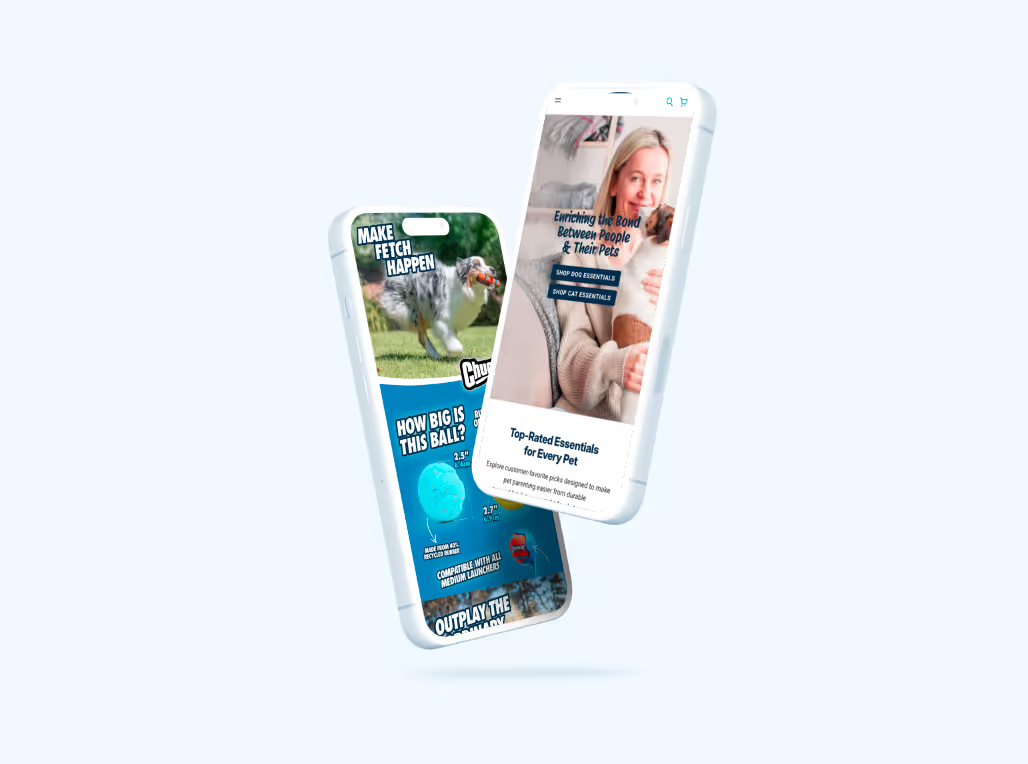

Digital Marketing & DTC Growth: Building Brand Beyond Marketplaces
While marketplaces provide scale and infrastructure, marketplace-only strategies create dangerous dependencies: platform policy changes can devastate businesses overnight, fee increases erode margins with no recourse, and customer relationships belong to Amazon/Walmart, not your brand. Smart brands balance marketplace revenue with owned channels - particularly Shopify DTC stores and TikTok Shop - where they control customer experience, capture first-party data, and build lasting brand equity.
Our digital marketing and DTC growth service builds brand awareness and drives sales beyond marketplaces through paid social advertising (Facebook, Instagram, TikTok), TikTok Shop management for social commerce, Shopify store development and optimization, influencer marketing campaigns, and email and lifecycle marketing. This integrated approach builds sustainable brand equity while feeding marketplace growth through increased branded search volume.
DTC and marketplace strategies aren't competitive - they're mutually reinforcing. Social media advertising drives brand awareness that translates into Amazon search volume (where your cost-per-click is lower due to higher conversion rates). TikTok Shop introduces products to younger demographics who later repurchase on Amazon Subscribe & Save. Shopify customer data informs marketplace product development and messaging. We coordinate strategies across all channels through unified analytics via iDerive, ensuring digital marketing investments amplify marketplace performance.
Digital Marketing Services


Digital Marketing Services

Digital Marketing Channels: Paid Social, TikTok Shop & Influencer Growth
Paid social advertising builds upper-funnel brand awareness and drives consideration through Facebook, Instagram, and TikTok campaigns. These platforms excel at reaching cold audiences, testing creative messaging, and building social proof through engagement. We develop scroll-stopping creative, target high-intent audiences (competitor followers, lookalikes of purchasers), and optimize for both immediate conversions and long-term brand lift measured through marketplace branded search increases.
TikTok Shop represents the fastest-growing ecommerce channel, offering seamless in-app purchasing for TikTok's 170M+ US users. Our TikTok Shop management combines content strategy (organic posts and paid promotion), influencer partnerships to drive authentic product discovery, livestream shopping events, and Spark Ads that amplify high-performing organic content. TikTok Shop works particularly well for beauty, wellness, fashion, and lifestyle products targeting younger demographics.
Influencer partnerships drive authentic product discovery and third-party validation. We identify micro-influencers (10K-100K followers) with engaged audiences in your category, negotiate performance-based partnerships (affiliate commissions or flat fees), manage content creation and approval workflows, and track campaign performance including influencer-driven sales through affiliate tracking and promo codes. Strategic influencer marketing generates both immediate sales and long-term brand awareness that compounds over time.
Shopify DTC: Building Your Owned Ecommerce Foundation
A high-converting Shopify store forms the foundation of DTC success. Our Shopify development service builds custom-designed stores optimized for conversion: mobile-first responsive design (70%+ of traffic), strategic product categorization and navigation, compelling homepage messaging and social proof, streamlined checkout flows that reduce cart abandonment, and technical optimization for page speed and SEO. We launch stores in 4-6 weeks with ongoing conversion rate optimization.
Building traffic requires coordinated acquisition strategies: Google Shopping and Search campaigns to capture high-intent searchers, SEO optimization for organic discovery, Facebook/Instagram retargeting to re-engage site visitors, and strategic partnerships and PR to build backlinks and brand credibility. We develop full-funnel strategies that balance immediate sales (lower-funnel tactics) with long-term brand building (upper-funnel awareness).
Email and SMS marketing maximize customer lifetime value through welcome series, abandoned cart recovery, post-purchase follow-ups, replenishment reminders, VIP programs, and seasonal promotions. For consumable products, subscription programs (Subscribe & Save on Shopify) drive recurring revenue and improve unit economics. Email marketing typically generates $36-42 ROI per $1 spent - making it the highest-ROI channel for brands with strong customer retention.
FAQ
Sell on Amazon first if you have a simple product and category fit and want speed-to-revenue. Expect first sales within 30 days. Sell on Shopify first if you already have social traffic or press and want to protect margin and brand control while finding product-market fit (90–180 days). For a first-time brand without traffic, Amazon first is usually cheaper. For a brand that already has social traffic or press, Shopify first protects your margin while you build category credibility. The decision is really about whether you’re paying to discover customers (Amazon) or paying to keep ones who already know you (Shopify).
Yes, and most scaling brands sell on Shopify and Amazon simultaneously. The failure mode is running them as isolated silos, treating Amazon as a pure revenue channel and Shopify as your “real” brand. The better frame: Shopify is your owned audience and first-party data; Amazon is your acquisition engine and discovery surface. Most mid-size brands land at 50–70% Amazon revenue and 30–50% Shopify, with the Shopify share growing as the brand builds direct traffic. Duplicate listings, pricing mismatches, and conflicting promos are the three most common mistakes.
Every Shopify store needs five email flows on day one: welcome series (3 emails over 10 days), abandoned cart (2–3 emails within 24 hours), browse abandonment (1 email), post-purchase (thank-you, review request, cross-sell over 14 days), and win-back (60+ days inactive). (1) Welcome series: 20–30% of email list value. (2) Abandoned cart: recovers 8–15% of carts. (3) Browse abandonment: 3–5% lift on unconverted product views. (4) Post-purchase: thank-you + review request + cross-sell over 14 days. (5) Win-back: recovers 5–10% of lapsed buyers. Miss any one and you’re leaving 15–25% of potential email revenue on the table before you send a single campaign.
Facebook Ads Manager shows more sales than Shopify because of attribution-window and tracking-coverage differences. Facebook reports 7-day view-through conversions and cross-device journeys via the Meta pixel, while Shopify reports only last-click conversions within a single session. The mismatch is usually 30–50% inflation from Facebook. To reconcile, use Shopify’s last-click data as your floor truth and a media mix model or holdout test for the halo. Trusting Facebook’s number for budget decisions is how brands overspend by 20–30% on Meta.
Yes. You still need Conversions API even with the Meta pixel on Shopify. The pixel alone loses 15–30% of conversion events post-iOS 14 because Safari and third-party ad blockers strip browser-side tracking. Conversions API sends events server-side from your Shopify backend, recovering most of that loss. Shopify’s native Meta integration deploys CAPI automatically since 2023. If you haven’t enabled it, that’s probably the highest-ROI 10-minute fix in your marketing stack. Brands that run pixel-only often see 30–50% reported Meta ROAS uplift within 2 weeks of enabling CAPI properly.
Amazon has 300M+ shoppers and intent-rich search volume. It's the cheapest customer acquisition channel for most mid-size CPG and eCommerce brands. Shopify has your CRM, email list, subscription data, and direct customer relationship, everything needed for LTV. The hybrid play: win a customer on Amazon at an efficient CAC, then move them to Shopify Subscribe via insert cards, warranty registration, or post-purchase email capture. The math only works if you actually build the handoff; most brands intend to but never do.
Not inherently, but specific mistakes can. Pricing parity (selling cheaper on Amazon than your DTC site) trains customers to always check Amazon first. Letting third-party resellers dominate your Amazon Buy Box erodes brand control. Skipping A+ Content and Brand Store makes your Amazon listings feel commodity. Brands that get Amazon wrong absolutely hurt their Shopify margin and brand equity. Brands that treat Amazon with the same creative discipline as their DTC site tend to see Amazon strengthen the brand rather than dilute it.
Case Studies
See how Nectar's creative and strategy work has lifted partner brands into category leadership and, in several cases, opened growth channels the client hadn't yet considered.