{
"@type": "Article",
"image": {
"url": "https://csuxjmfbwmkxiegfpljm.supabase.co/storage/v1/object/public/blog-images/organization-10884/1773554735030_image.png",
"@type": "ImageObject",
"caption": "Ecommerce team reviewing marketplace performance"
},
"author": {
"url": "https://thinknectar.com",
"name": "Dan Katona's Organization",
"@type": "Organization"
},
"@context": "https://schema.org",
"headline": "Why marketplace optimization matters for ecommerce in 2026",
"publisher": {
"url": "https://thinknectar.com",
"name": "Dan Katona's Organization",
"@type": "Organization"
},
"inLanguage": "en-US",
"articleBody": "Discover why marketplace optimization drives measurable growth in conversions, ROAS, and revenue for ecommerce brands on Amazon, Walmart, and Shopify in 2026.",
"description": "Discover why marketplace optimization drives measurable growth in conversions, ROAS, and revenue for ecommerce brands on Amazon, Walmart, and Shopify in 2026.",
"datePublished": "2026-03-15T06:06:27.374Z"
}
Why marketplace optimization matters for ecommerce in 2026
.webp)

Great products do not automatically translate into strong marketplace performance. For instance, Best Choice Products achieved a 50% increase in total sales revenue purely through strategic marketplace optimization. The difference between mediocre and exceptional results hinges on how well you optimize listings, advertising, pricing, and customer engagement across platforms like Amazon, Walmart, and Shopify. This guide explains why optimization is essential for growth in 2026 and how to leverage it for measurable gains.
Key Takeaways
- Revenue impact: Strategic optimization can drive up to 50% increases in total attributed sales revenue.
- ROAS improvement: Data-driven tactics consistently deliver 20-30% improvements in return on ad spend.
- Conversion gains: Focused efforts typically yield 15-20% increases in marketplace conversion rates.
- Platform specificity: Amazon, Walmart, and Shopify require unique, tailored approaches based on their distinct algorithms.
- Continuous testing: Sustained competitive advantage requires ongoing A/B testing across all touchpoints.
Understanding the Impact of Optimization
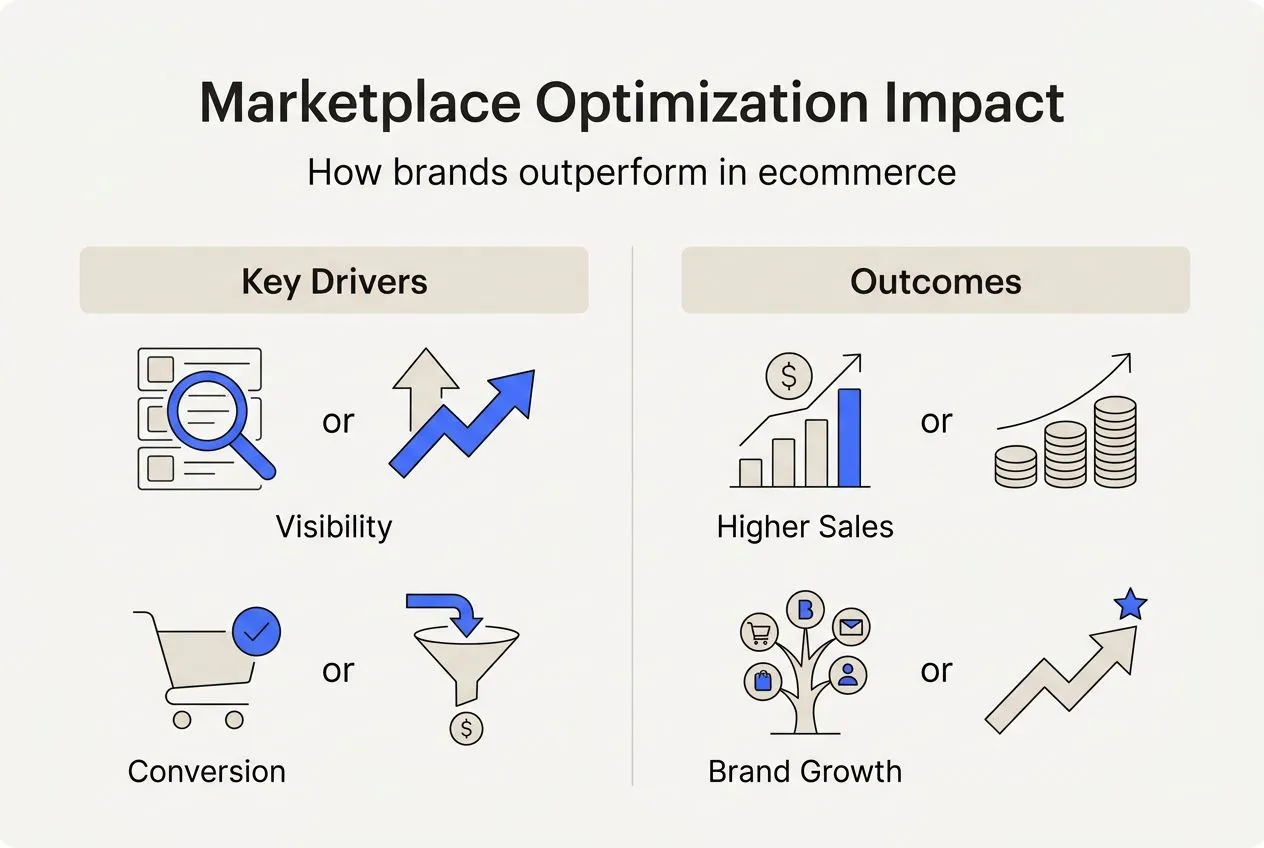
Marketplace optimization is the systematic improvement of every element that influences your brand’s performance from refining product listings and visual assets to calibrating pricing and ad campaigns.

Marketplace algorithms reward relevance, customer satisfaction, and conversion history. Brands that optimize for higher sales gain algorithmic advantages that compound over time, creating a virtuous cycle of improved visibility. It is not a one-time project, but an ongoing discipline that creates competitive separation in saturated categories.
Key Metrics and Strategies for Success
To evaluate effectiveness, track three critical KPIs:
- Conversion Performance (Conversion Rate, Add-to-Cart): Improve this through listing quality, competitive pricing, review generation, and superior product imagery.
- Advertising Efficiency (ROAS, CPC, Impression Share): Optimize this via targeting precision, bid strategies, and continuous creative testing.
- Revenue Growth (Total Sales, AOV): Scale this by refining product assortment, utilizing cross-sell tactics, and executing strong promotional strategies.
Pro Tip: Focus initial optimization efforts on your top 20% of SKUs by revenue. Improvements here typically deliver 80% of total performance gains with minimal resource investment. Additionally, prioritize mobile optimization, as mobile now represents the majority of marketplace traffic.
Tailoring Approaches by Platform
Do not apply generic tactics across different marketplaces. Each platform demands a distinct playbook:
1. Amazon: Maximum Reach
- Algorithm Focus: Keyword relevance and conversion history (the A9 algorithm).
- Optimization Priorities: Meticulous SEO, backend keywords, review velocity, and robust A+ content.
- Ideal Profile: Established brands seeking massive scale in highly competitive categories.
2. Walmart: Price & Availability
- Algorithm Focus: Price competitiveness and inventory availability.
- Optimization Priorities: Strict pricing control, inventory health, and sponsored products. (Our Q4 ecommerce strategy guide highlights how Walmart's positioning creates unique peak-season opportunities).
- Ideal Profile: Value-focused brands with highly efficient logistics.
3. Shopify: The DTC Experience
- Algorithm Focus: Website user experience and marketing integration.
- Optimization Priorities: Site speed, frictionless checkout, and integrated email/social campaigns.
- Ideal Profile: DTC brands focused on owning the customer relationship and maximizing margins.
Practical Steps for Implementation
Transforming optimization from concept to reality requires a structured approach:
- Audit Your Presence: Evaluate listing accuracy, ad efficiency, pricing parity, and inventory health across all channels.
- Prioritize Quick Wins: Fix listing errors and obviously inefficient ad bids before moving to heavy lifts like complete catalog overhauls.
- Leverage Data Analytics: Establish clear baselines. Use granular data to track customer behavior and campaign performance.
- Test Continuously: Systematically A/B test titles, main images, and promotional tactics. Crafting compelling ecommerce ads relies on hard data, not assumptions.
- Monitor Competitors: Track competitor pricing and new product launches to proactively defend your market share.
Brands seeking to maximize PPC efficiency or focus on optimizing ad spend must embed these steps into regular weekly processes rather than treating them as sporadic projects.
How Nectar Helps Brands Master the Marketplace
Marketplace optimization demands specialized expertise. Nectar delivers comprehensive ecommerce services tailored to brands selling on Shopify, Amazon, and Walmart.
We blend high-impact creative assets with data-driven strategy. As demonstrated in our Shopping Trip Shopify case study, our end-to-end ecommerce creative services including professional photography, videography, and listing design elevate brand presentation globally. Powered by our proprietary iDerive analytics platform, we provide the granular insights mid-sized and enterprise brands need for profitable brand growth and long-term ROI.
Frequently Asked Questions
What is marketplace optimization?
It is the systematic process of enhancing product listings, ad campaigns, and pricing strategies across platforms like Amazon, Walmart, and Shopify to increase visibility, conversion rates, and total sales.
How long does it take to see results?
Quick wins (like fixing listing errors or adjusting bids) often show results in 2-4 weeks. Substantial, compounding algorithmic gains typically emerge over 8-12 weeks of sustained optimization.
What is the typical ROI?
Most successful programs yield 20-30% improvements in ROAS and 15-20% increases in conversion rates, though brands with significant optimization gaps can see much higher initial returns.
Should I optimize all marketplaces simultaneously?
No. Begin with your highest-revenue marketplace to maximize immediate business impact. Once processes are established, expand proven tactics to secondary platforms.
Do I need specialized tools?
While basic manual optimization is possible, specialized analytics platforms and competitor monitoring software provide the speed, depth, and efficiency required to truly scale, especially for large catalogs.











.png)